The Mooseman Cometh
By Spencer Baselice
Photos by Rick Libbey and Spencer Baselice
After spending a short time with this photographer, it is easy to see why he is “on the moose!”
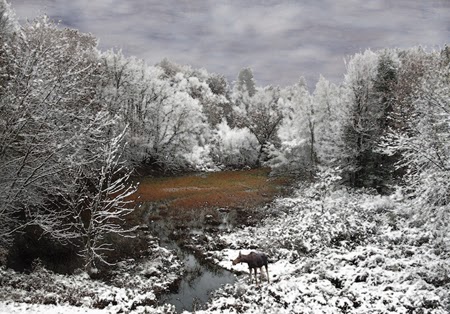
It's mid-July, peak moose watching season, and Rick Libbey, who is known as The Mooseman, slowly moves his kayak across the bog cautiously, edging closer to a 1,200 pound bull taking his fill of sodium-rich plant life to help his antlers grow and harden before mating season this fall.
Suddenly, the moose's ears fold back, so The Mooseman takes a few short strokes of the paddle and moves his kayak several yards away, still watching the animal intently, and not making a sound, or moving his body an inch. He knows their behavior well, and he knows the signs to watch for. If the hair on the moose's back begins to rise, he'll paddle away swiftly. If the animal's tongue comes out, he should already be safely out of range.
 |
The “Mooseman” drew this “small” track in the dirt to
represent what a yearling’s footprints might look like.
A bull moose has a hoof print as large as a typical hubcap. |
It might seem a little crazy to get this close to an animal of such enormous size. Commonly known as gentle giants, moose do have a mean streak, and for large animals, they can run and swim extremely fast, with hooves the size of car wheels that double as defense mechanisms.
It could take him hours, days or weeks before this moose allows him to get as close as he needs to be in order to properly capture the essence of his experience with this animal. For him, there's simply no alternative. A long range shot from a large telephoto lens simply doesn't express the passion he has for the animals.
Libbey, who is now almost exclusively known as The Mooseman, has been photographing moose for 25 years, getting as close as possible to the animals, and using only a 300 mm lens mounted on a mono-pod inside his kayak to capture the entire moose in crisp detail. The smaller focal-length telephoto lens has a larger depth of field (or focusable area) than a larger, longer focal length telephoto lens would. So, every part of the moose is clearly defined. The lens is also physically smaller, so it also allows him the mobility and freedom to get extremely close to the largest members of the deer family, which he is so passionate about.

A telephoto lens (anything in the 1000 to 2000 range, and even as low as 500 mm) has a very small 'depth of field,' which means less of the picture is actually in focus. You can recognize a shot taken with a long focal length telephoto lens because it will have considerable background blur. Parts of the moose, possibly the antlers or throat will be out of focus, while only the eyes or nose remains in focus.
It's just part of The Mooseman's vision, and his way of relating the experience of being so close to the animals. He also uses no digital alterations or enhancement techniques, and uses only slide film—never digital, and he never crops a photo!
Getting so close to an Alces Alces (the scientific name for moose) is not simple. It takes a great deal of patience, an intimate knowledge of the animal, and a savvy approach which The Mooseman has developed during his many encounters with the animals. He believes it is his calling to be in the presence of moose and has been doing just that ever since he took a small Kodak camera with him on a trip into moose country with a friend back in 1981. He's been able to get as close as four feet from a young yearling moose, and stayed there for close to four hours. He notes this was one of the most inspiring moments of his life. Yearling moose are a little more curious and less 'world-wary' than their larger, more experienced counterparts, he admits, and a full-grown bull would have never let him get so close.
The most important part of getting this close to large animals is your initial approach. It's almost an art form itself. Most people will have scared off a moose long before they even know one is in the area.
The first thing to keep in mind is your own scent. Moving from downwind towards a spot where you think there might be a moose is a must. Moose have an excellent sense of smell, and if they smell you before they see you, they become agitated and will go charging through the woods. This is because they haven't had the time to process your presence by sight. If they see you first they can get used to you and will learn that you aren't a threat. Moose have few natural enemies, including bears, mountain lions and cougars, but they are cautious animals.

It also helps to become a bit of a moose behaviorist. The Mooseman will spend a great deal of time simply watching a moose's body language in order to figure out what "mood" the moose is in. This helps him gauge what type of approach to use, and whether a moose is likely to scare easily. It's something you will only learn over time, so it's best to just heed your own senses at first, waiting and watching, until you feel comfortable enough to move any closer yourself.
Moose-watching is becoming very popular all over the state. When I first interviewed The Mooseman last summer, moose-watching was just starting to catch on, and people had been asking him more and more questions about where to find moose everywhere he went. Now the pastime is really exploding, and his popularity is taking off with it. He spends a great deal of time now just answering emails and questions everywhere he goes. He is also becoming a well-known authority on moose behavior.
New Hampshire will hold the First Annual Moose Convention in New London on September 30, where The Mooseman will be speaking and helping to introduce “The Forever Locked Antler Project,” an incredible display of taxidermy preserving two moose who died of exhaustion when their antlers locked during a territory battle. The display is one-of-a-kind, and travels around the state on a special trailer which is as large as a full-length tractor trailer.
 |
Rick Libbey (aka The Mooseman) uses a 300 mm lens mounted
on a single-leg pole, to photograph moose in the wilderness. |
There just seems to be a connection between New Hampshire and moose. Maybe it's our laidback mentality and carefree nature which helps “Live Free or Die” residents gel with the large animal neighbors. Who knows? Whatever it is, people are drawn towards the curious giants.
So, how can you spot a moose this summer? The best way to increase your odds of spotting a moose is to go to the area with the highest moose density in the state, Pittsburg, where there are over 30 moose per square mile.
If you don't want to make that long of a drive, your best chance to spot a moose right now is near a bog or swamp, where they will be actively ingesting large amounts of the sodium-rich aquatic plants. It's no accident the moose's name translates into "twig eater." Moose pack away 50 pounds of food per day during summer in order to get ready for mating season in the fall, and they have four stomachs to help them along the way.
A moose's territory can be as large as five square miles (deer travel in a territory of only one square mile), so if you wait long enough in just the perfect spot, your chances of seeing one are fairly good.
You can also try your luck at any sparsely populated and wooded area in New Hampshire, since almost any area of the state is moose territory. They have been spotted on the seacoast and as far south as Massachusetts. A few more popular areas include the Kancamaugus Highway, Route 118, Route 114 near Warner, the Franconia area, and the entire White Mountain region. Those are just a few good places to focus on.
After a heavy rain, try looking along wooded roadsides and you might find a moose just slurping up mud. Spring runoff can create giant salt licks (called moose licks) in areas where roads have been heavily salted during the winter. It will appear that the animal is simply slurping up gallons of mud, but they are really eating the salt from the runoff.
Why do they like sodium? It helps to generate a hormone that hardens their antlers, which are the fastest growing living things on the planet, and a known aphrodisiac. They shed these antlers each year, so they must grow into those full racks you see on postcards in about six months. Each year, in April, the antlers begin as tiny bulbs on the moose's head, when they are referred to as "in velvet."
There are a few more things to keep in mind, The Mooseman says.
For the beginner or intermediate moose-watcher, it might be best to try and spot the moose from your car, and be sure not to get too close. Encounters with moose in the woods do happen, and most occur by chance, but they normally do not last very long.
If you go into the woods looking for a moose, take a tip from an expert moose- watcher. Carefully scan the trees directly in front of you for horizontal lines. Everything in the forest is vertically aligned, so any horizontal shapes will readily stand out.
If you come upon a moose, make sure not to make any sudden movements and keep quiet. Moose do not like to hear voices, and are likely to run off as soon as you start talking. Just keep in mind that the more cautious you are during your search and approach, the more time you will have to enjoy the moose's company.
It’s always exciting to see a live animal in its habitat, but if you take it slowly, and allow the animal to get used to your presence, once they grow accustomed to you, you can simply watch and enjoy.
If you can, try making sense of the animal’s body language, although this isn't always easy or precise, and you might be able to determine what mood the animal is in just by the way he moves. Most importantly, keep an eye out for those warning signs mentioned at the beginning of the article. A moose will tell you when he is getting ready to charge. If you see the ears point backwards, it is time to put some distance between yourself and the moose.
Not all moose are the same. In some cases, it can take several days for a moose to become accustomed to you, so don't feel disappointed if you aren't able to get really close to one. Sometimes The Mooseman will spend an entire week earning an animal’s trust but it's worth it, because when they do become comfortable, you can spend hours simply observing and snapping some of the most inspiring images you've ever seen in nature. The longest encounter he said he ever had was around four hours.
The Mooseman has taken years to understand the animals and now says he has a pretty good feel for the way they are going to act. He also has a few additional tricks to help bring moose to him when he can't find them. He can actually call moose in from the woods using a vocal 'bull call' in areas where there are more moose.
Remember, moose will always be found near their food, since they are fast- growing animals.
A yearling moose, born in May, weighs between 30 and 40 pounds, and by winter it has increased in size 1,000 percent, to a standard weight of 400 pounds.
If you are trying to locate a moose by tracks, keep in mind a bull moose hoof print can be larger than a sedan's hubcap, and the moose could be miles away if the prints aren't fresh.
They are not easy animals to spot in the wilderness, and Libbey, who posts his photos and shares moose stories on his website,
www.moosemannaturephotos.com, said many encounters happen by chance. Those are always the most interesting stories. So, keep your head if you do see a moose, and always be courteous.
The biggest weapon in your arsenal when watching moose, especially if you want to eventually get up close and personal, will be patience, patience, patience. That’s what separates his unique photos from the other photographers who snap shots from hundreds of feet away.
You can arm yourself to be a successful moose stalker just by following the few tips outlined above, and always use common sense.
The Mooseman’s photos have been on display at several New Hampshire galleries, including the Gallery at Well Sweep in Hillsborough, NH, and many are online at his website. The Mooseman is currently helping to spread moose awareness through his art and his knowledge about the animals. You can contact him through his website.
Ed note: Provided by Heart of New Hampshire Magazine and published here so that the historic wealth of information would not be lost.